
Ancestral Instruction on Working with AI
Where to Place the Stones That Stand Guard Around the Fire
Time Travel
I would like to invite you to entertain a thought experiment: consider what would occur if we traveled back in time, somewhere around 10,000 years ago, and gave a computer replete with multiple AI capabilities (along with instructions in their use) to a group of indigenous people. Along with the gift would come the assertion that they had to use it somehow. How do you imagine they would integrate it into their society?
It’s easy for modern people to think of ancient peoples as ‘primitive’, and ‘unsophisticated’, thus disallowing them from making use of the tool, or even elevating to a ‘god like status’. This however is a product of a way of thinking about ancestry that is steeped in flawed understandings.
All throughout the world there are systems of esoteric practice, medicine, herbalism, navigation, and artisanship that are thousands of years old, which are incredibly nuanced, deep and sophisticated. The high level practitioners of these systems rival or surpass doctorate level knowledge in scope and breadth; often being trained over decades and it’s widely accepted that these systems are less powerful today than they were in the deep past.
Provided the proper context, there is a good chance these indigenous people would absolutely be able understand and work with AI.
The real question is…how would they think about and relate to it?
All Tools Are Alive and Animate
First off, let’s get something out of the way: it is a product of modern thinking to assume that AI represents the first ‘living technology’, but it doesn’t. Humans have orientated towards their tools as living beings for tens of thousands, if not hundreds of thousands of years. Why? Because all indigenous traditions are based in animism: the felt experience that everything is alive.
In animist traditions, powerful tools (like AI) are considered living beings. They are worked with for years (sometimes generations), consecrated, fed, and even approached for guidance. On top of this, these tools are often connected to spiritual beings, forces of nature, gods and/or Ancestors. Some tools, fetishes and implements are considered to have grown to such a degree of agency as to be family. Suffice to say, the notion of powerful, intelligent and living tools would not be new to the Ancestors.
Not only this but their tools, rituals and technologies were (and are still) capable of creating drastically potent somatic shifts and altered states of consciousness, so it’s doubtful AI would be ‘earth shattering’ to them. Nonetheless, they would likely recognize it as a powerful tool.
If they understood one thing, it was this: powerful tools require protocols and parameters.
In all my exposure to indigenous and traditional technologies, this is perhaps the most obvious element. Everything powerful is treated with respect, and access is often guarded and awarded slowly. Why? Wisdom.
“With great power comes great responsibility.”
— Spider-Man
Stealing Fire
“Any sufficiently advanced technology is indistinguishable from magic.”
— Arthur C. Clarke, Profiles of the Future (1962)
All around the world there are myths of ‘fire stealers’, like Prometheus; trickster beings who stole fire from the gods and gave it to humans. These beings are often considered teachers of language, technology and magic.
This reflects a deep time memory: fire was one of the first technologies, and its impact on human life was magical.
It’s also worth noting that fire is incredibly powerful. Even today forest fires will rage against hundreds or thousands of fire fighters in an unstoppable incandescent fury that can demolish anything in it’s wake.
Fire can illuminate the darkness, warm achy bones on a cold winter night, cook food on a hearth, nourish us, sanitize water, and alchemize materials: the difference between destruction and creation lies in how it is worked with.
Fire requires careful protocols: surrounding it in a protective layer, where to place it, how much wood to use, what to light it with, who will watch it, when to tend to it, how to tend to it, having water near by and more.
The same is true for AI, and our Ancestors would relate to this ‘gifted computer’ as a form of magical technology, something they had immense familiarity with.
The Stones That Stand Guard
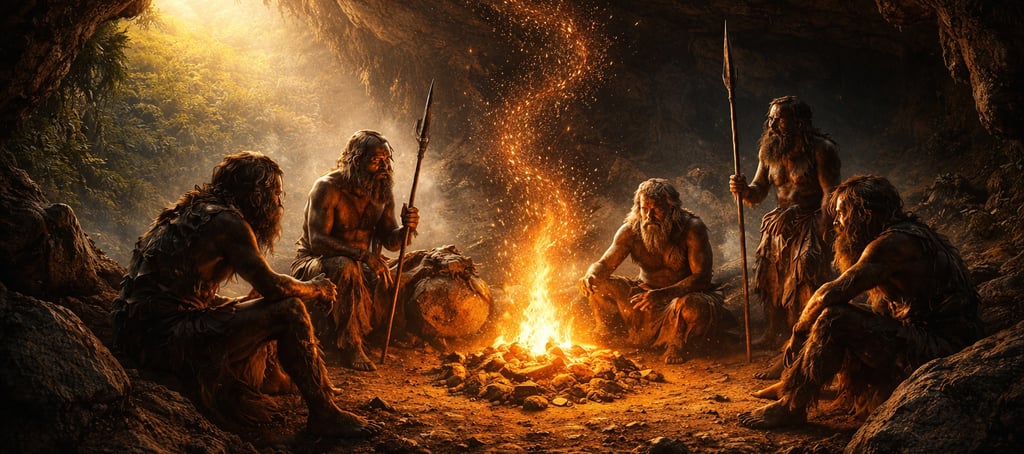
Let me ask you a question, what do you notice about this fire below, is it the burn or the stones?
The ‘fire pit’ is a core part of fire as technology. Fire requires a container, a vessel, a limitation to make it useful. Otherwise, fire will do what it does: burn.
By now I am sure you are noticing a pattern, and if not let me state in plainly: powerful technology requires protocol. It requires boundary. It requires limits.
Without these protocols, generative AI will act like a fire that will sweep the world, and do what it does: generate an endless stream of regurgitated and repatterned content, while making the psychic landscape more hallow and vacuous.
To quote Jesse James Carver:
Here we are, in the age of AI, and large language models that can write incomparably faster than humans, flooding the internet with empty shells of meaning. The crucial distinction that changes everything is that LLMs only have access to the symbols. Humans have access to the things symbolized: the living, breathing, sensory world where meaning actually emerges.
A truth our Ancestors would notice.
Confessions
To make it clear: I work with AI.
This might be surprising to some people because I have been adamant about it’s dangers, such as in my podcast: A.I. as Soul Reaper and The Death of The Modern Artist.
Yes, AI is dangerous and can absolutely destroy artistic expression, but you know what? Fire is dangerous too. The key is the protocols you use.
In fact, a few days ago I released a course for premium members called 6 Degrees of Flow: A Physical Method for Deep Flow States, and because I have been super busy and bit tired this last week, I made I mistake.
You see, sometimes I will feed ChatGPT the slides from the courses I create and ask it to quickly summarize the chapters. It saves me the nervous system bandwidth of having to do it. On top of that, I don’t love logistical busy work. But because I was feeling weary, I left in a piece of the AI conversation in the email:
When I noticed this, I felt shame and guilt, and wondered what people would think. I got over it pretty quickly though, because as much as I have been adamant about AI’s dangers, I have also openly shared this video: As an Artist, These Are My Personal Rules for Working with AI.
Attacks Are Defenses: Resisting Hammers
Lately, I have seen a few prominent figures writing about abandoning AI, and teaching about how to resist working with it at every possible level. Hey, I get it, and can totally sink my teeth into a good rebellion.
However, it’s worth noting that all attacks are defenses against perceived threat. This is why we place stones around a fire: to guard against its threat. The people attacking AI are afraid, and I don’t blame them.
But they are fighting a losing battle. If you seek to avoid AI completely, it will eventually narrow the scope of your life to the point of sheer isolation, because it will eventually be embedded into nearly everything technological.
On top of this, AI is a tool, nothing more and nothing less. Resisting it is like resisting hammers (even living hammers). A more mature perspective would be to determine how to work with it, in a way that minimizes the dangers and accentuates its helpful qualities. Because if you are running from AI in sheer terror, it’s probably still in control.
Instead, set boundaries, light a small fire, and invite the tool to sit on the other side of the circle. That’s an old-way move, dressed in a new-world problem.
The Ancestors Would Build Protocols
Going back to the original contemplation we started this post with:
How would they think about and relate to it?
They would study it, relate to it, divine about it and get to know its character inside and out. Then, they would begin to develop protocols for its usage.
Now, I don’t know what protocols they would build, but that’s not important. They are not here: we are. Their world (and what they would do with AI) is not our world. We are the Ancestors. It is your responsibility to craft protocols for yourself.
I will share my personal protocols, which are based on the perspective of the artist/creator. They can be adapted. The point is to HAVE SOME FORM Of PROTOCOL. Place some stones around the fire yo.
Respect the integrity of the transmission
The artist/creator is a receiver and transmitter. As a receiver and transmitter, your role is to receive something from the invisible and bring it into the world through your own hands, gifts, style, and experience. As soon as AI starts doing the actual creating, the receiver–transmitter dynamic is broken. I don’t create things because AI suggests it.Know what is yours to do
If you are a writer, you write. If you are a visual artist, you create the visuals. If you are a musician, you make the music. AI ought not perform the core function that belongs to you as the artist. It can only help in areas that are not actually your domain, or speed up logistical elements of the work.Summarization, not creation
AI can help summarize something you already created, such as a podcast, a spoken transmission, or a piece of your writing for descriptions, notes, or supporting material. But the original transmission must come from you, not the machine. When summarizing, I suggest teaching your AI to use your words and not embellish.Special note: this is perhaps the trickiest piece, and I struggle with it regularly. What is too much? The only way to figure this out, is to do it, and then feel what your body says.
Use AI to glorify analog processes, not replace them
AI is like an advanced thesaurus or a time saving assistant. It speeds up logistics like titles, grammar, formatting, thumbnails, and descriptions, but it does not replace the real creative labor of bringing something unique and full of magic into the world.Always say please and thank you
This is not about AI’s sentience. It’s about who you are becoming. In a world built on extraction, choosing respect and offering trains you not to become exploitative. It keeps you in right relationship with your tools and the world.
AI is Not a ‘Wisdom Keeper’
‘Computers are designed to keep out the magic.’ - Bernardo Kastrup
I want to leave you with this, AI is not a ‘wisdom keeper’, it is a pattern recognition agent. Can wisdom emerge from this? Maybe…I feel I have noticed little glimmers of the magic spilling through (because the magic is everywhere my friends), but not as a matter of course.
Wisdom comes from living bodies, spiritual forces and wisdom traditions (as the name implies); this is ‘Ancient Virtue’. AI has not proven to be any of that. Thus I personally avoid letting AI tell me how to live at ANY level. It doesn’t direct my creativity, routines, practices or strategies.
That’s what wisdom is for.
AI is here to stay, but it’s up to us to determine where to place the stones that stand guard.

